



Product failures can have serious consequences, because users rely on products to perform safely and as intended. When a product fails unexpectedly, the result can be detrimental—leading to injuries from falls, crushing, striking, entrapment, collapse or other mechanisms the human body cannot withstand.
Despite advances in design, manufacturing, automation and quality assurance, product failures still occur—and the reasons are often complex. Failures may arise from design defects, manufacturing faults, inadequate warnings, material fatigue, poor maintenance, misuse, or a combination of these factors. Determining why a product failed—and who may be responsible—often requires detailed technical investigation.
At Dohrmann Consulting, our engineers and ergonomists use engineering, biomechanics and human factors principles to investigate the cause of product failures and their role in the event of injury. We examine not only how a product failed mechanically, but also whether the product was reasonably safe in the context of how people could be expected to use it.
A critical issue in many product failure matters is the relationship between intended use and foreseeable use. While manufacturers design products for specific purposes, they also have responsibilities to anticipate reasonably foreseeable misuse and ensure products remain as safe as practicable, including through design safeguards, warnings, instructions and testing. Where that balance sits can be central to determining liability.
Our investigations consider the full chain of causation, including:
We review quality assurance records, testing documentation, maintenance records and product specifications, and where possible inspect the failed product itself to understand where the breakdown occurred. By combining engineering analysis with ergonomics and human factors expertise, we assess whether the failure arose from a defect, a systems issue, misuse, or an interaction of several factors.
This work is often essential because liability in product failure matters can be difficult to untangle. Responsibility may involve manufacturers, designers, suppliers, installers, maintainers or users, and expert investigation is often required to understand where the failure originated.
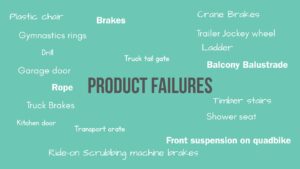
We have investigated a wide range of product failures, including:
It is concerning when products that have passed through sophisticated design and quality assurance processes still fail and cause injury. But understanding why they failed is critical—not only to determine causation and assist with liability, but to help prevent the same failure from injuring someone else.
At Dohrmann Consulting, we investigate product failures to identify what went wrong, why it happened, and whether it could have been prevented. Because what may appear to be a simple product malfunction can often reveal deeper issues in design, safety or human-product interaction.

Use this structured tool to gather comprehensive details of the circumstances.